
#TSW
The MEDIATE Initiative (Mitigating Eczema Disinformation and Intervening with AI Technology Education) is a project focused on developing an autonomous digital intervention for self-diagnosed Topical Steroid Withdrawal (TSW).
The Clinical Challenge
The dermatological community is increasingly facing the consequences of poor treatment adherence aggravated by “corticophobia”. This challenge has been exacerbated over the past decade by the rising public awareness of TSW, a narrative now predominantly dictated by social media. Patients experiencing rebound flares of undertreated atopic dermatitis often encounter medically inaccurate, alarmist content online. Consequently, many self-diagnose with TSW, abruptly stop all topical corticosteroid (TCS) use, and pursue unproven alternative therapies.
Project Overview and Methodology
To bridge the gap between evidence-based dermatology and digital peer communities, the MEDIATE Initiative proposes an automated digital agent powered by a domain-specific Large Language Model (LLM). Developed through a collaboration involving the Universidade de Sao Paulo, Insper, Imperial College London and the Royal College of Art, the 12-month study utilizes a three-phase observational and simulated design:
- Data Mining & Psychological Mapping:
The project systematically mines community data to analyze online narratives, map misinformation, and understand how patients seek and interpret information regarding TCS and TSW. - RAG-Constrained Development:
The AI agent is being co-designed to utilize a Retrieval-Augmented Generation (RAG) architecture. To prevent hallucinations and ensure psychological safety, all outputs are strictly grounded in a curated knowledge base of dermatologist-validated guidelines (including IEC, ISAD, AAD, and EADV). - Simulated Sandbox Testing:
The agent is exclusively tested and evaluated within a secure, isolated simulated “sandbox” environment using the mined data, ensuring no contact with real patients or live social media users.
Evaluation and Expected Impact
To guarantee safety and efficacy, the project employs a Blind Multidisciplinary Review. A panel of board-certified dermatologists and clinical psychologists will rigorously grade the agent’s simulated outputs for medical accuracy, guideline adherence, and psychological safety. Ultimately, this project aims to deliver a robust, safety-proven framework for AI-driven health education that can mitigate the abrupt cessation of TCS and provide clinicians with deeper insights into patient anxieties.
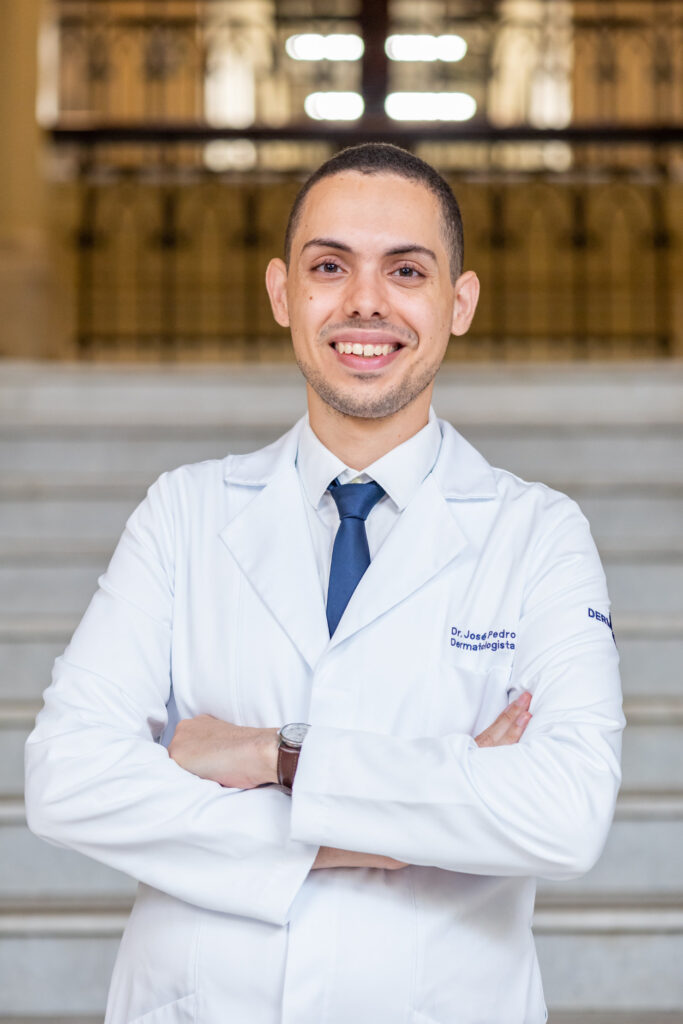
Dr. José Pedro de Almeida Silva
earned his medical degree from Escola Paulista de Medicina (UNIFESP) and completed his Dermatology residency at the Universidade de São Paulo (HCFMUSP), where he currently serves as Chief Resident. His clinical background includes a recent observership at Hospital 12 de Octubre in Madrid and academic leadership as a Resident Representative. Dr. Almeida Silva possesses a robust research foundation, previously leading an award-winning retrospective cohort study on dermatologic surgery outcomes and investigating patient treatment adherence. Building upon this strong academic background, his current research interests center on the intersection of clinical dermatology, digital health, and health communication.